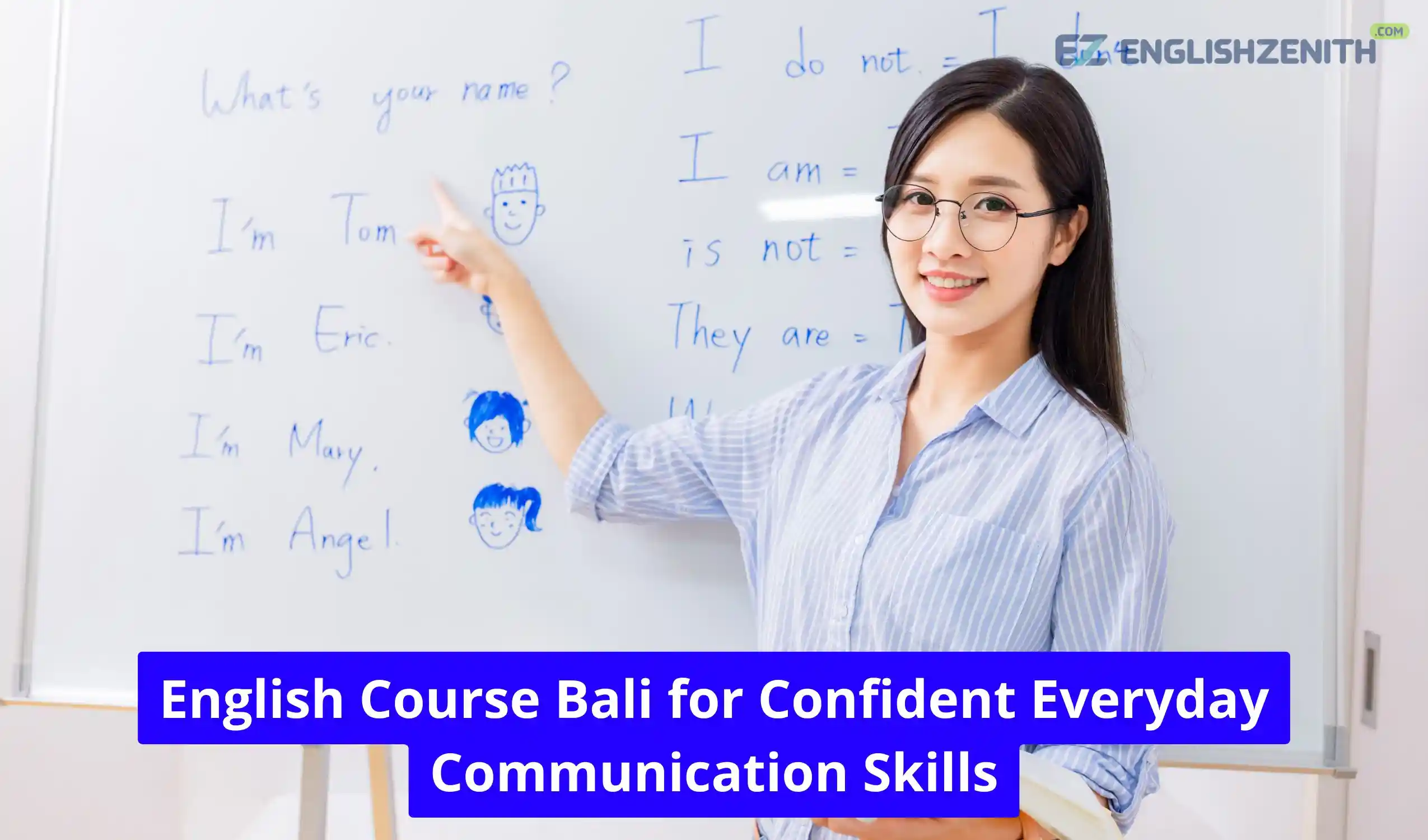
Discover an English course Bali learners can use to improve speaking, listening, grammar, pronunciation, and practical communication with personalised guidance.
English Course Bali for Practical English Learning
Choosing an English course Bali programme can make a significant difference when you want to use English more naturally in everyday situations.
For many learners, knowing grammar rules does not automatically lead to comfortable communication. You may understand written English yet hesitate when speaking, searching for the right words, or responding to someone in real time.
A well designed English course connects these areas through practical lessons. Instead of studying isolated vocabulary or memorising grammar patterns, learners practise how English actually works in conversations, professional settings, academic environments, and daily life.
English Zenith provides a structured approach for learners in Bali who want more than a traditional classroom experience.
Lessons can focus on communication, pronunciation, vocabulary, grammar, academic English, business communication, or specific personal goals.
What Is an English Course in Bali
An English course in Bali is a structured learning programme designed to develop practical English skills through guided lessons and consistent practice.
Depending on the programme, learners may work on speaking, listening, reading, writing, pronunciation, vocabulary, grammar, or professional communication.
However, effective English learning does not require every learner to follow exactly the same path.
A university student preparing for an international programme may need academic vocabulary and presentation skills.
Meanwhile, a hospitality professional may need conversational English, customer interaction, and workplace expressions.
Similarly, children attending an international school may need support with classroom communication, reading comprehension, writing, and confidence when expressing ideas.
Therefore, the most useful course starts with the learner rather than simply following a fixed lesson sequence.
Why Choose an English Course Bali Learners Can Use
English becomes more valuable when learners can transfer classroom knowledge into real situations.
For example, a learner may study the phrase “Would you mind” in a grammar lesson. However, the real learning happens when that learner can naturally use the expression while making a request.
The same principle applies to pronunciation.
A learner may recognise a word while reading but struggle to pronounce it during conversation. With guided practice, listening exercises, repetition, and immediate correction, pronunciation can become more natural over time.
Furthermore, regular speaking practice helps learners become more comfortable responding without translating every sentence mentally.
That practical connection makes an English course more than a collection of lessons. It creates a learning environment where knowledge becomes usable communication.
English Speaking Course Bali for Natural Communication
Speaking often becomes the main priority for adults and students who already understand basic English but still hesitate during conversations.
A strong speaking programme gives learners opportunities to speak frequently rather than spending the entire lesson listening to explanations.
Lessons can include discussions, role plays, question and answer activities, storytelling, presentations, interviews, and everyday conversations.
For example, learners can practise introducing themselves, discussing their work, explaining an opinion, asking for clarification, making arrangements, or handling an unexpected situation.
As a result, speaking practice becomes connected to real communication instead of isolated exercises.
English Conversation Practice in Bali
Conversation practice helps learners develop speed, vocabulary recall, listening awareness, and natural responses.
Instead of preparing every sentence before speaking, learners gradually learn to react to questions and situations more spontaneously.
A conversation lesson might explore travel, food, work, education, hobbies, current interests, or professional topics.
The teacher can then identify recurring language patterns that need attention and turn them into useful practice for the next lesson.
English Course Bali for Children and Teenagers
Children and teenagers often need a different learning environment from adult learners.
Younger students benefit from activities that combine language development with interaction. Games, stories, visual materials, conversation activities, reading tasks, and creative exercises can make English more engaging.
Teenagers may need a more academic approach as they prepare for school assessments, international programmes, university applications, or future study abroad.
For this reason, an effective English course can adapt its teaching style according to age, level, interests, and learning objectives.
Parents can also look for programmes that encourage students to use English beyond the classroom.
When English becomes part of regular communication, learners gain more opportunities to build vocabulary and develop natural expression.
English Course Bali for International School Students
Bali has a diverse international education environment, and many students use English as part of their academic life.
Students may need support with classroom discussion, essays, presentations, reading comprehension, research tasks, or subject specific vocabulary.
An English programme for international school students should therefore consider the academic demands they face.
For example, a student who speaks English comfortably may still need help organising an argumentative essay.
Another student may communicate well socially but struggle to explain complex ideas during a presentation.
Academic English training can address these differences while helping students become more independent learners.
English Course Bali for Academic Success
Academic English requires more than conversational ability.
Students often need to understand complex texts, identify key arguments, explain evidence, write structured responses, and present ideas clearly.
Therefore, academic English lessons can combine language development with practical study skills.
A learner might practise summarising an article before progressing to analytical writing. Later, the same learner can develop presentation skills and learn how to explain evidence clearly.
This approach creates a stronger connection between language ability and academic performance.
Students preparing for university can also develop the communication skills they may need in lectures, seminars, group projects, interviews, and presentations.
Business English Course Bali for Professionals
Professionals often learn English because their work requires clear communication.
Business English may involve meetings, presentations, email communication, negotiations, networking, interviews, customer service, or workplace conversations.
For example, a hotel manager may need to handle international guests professionally.
A business owner may need to present ideas to overseas partners.
A tourism professional may need to explain services clearly to international visitors.
Consequently, professional English should focus on situations that learners actually encounter.
Rather than learning business vocabulary without context, learners can practise realistic workplace scenarios and develop language they can use immediately.
English Course Bali for Tourism and Hospitality
Bali attracts visitors from around the world, making English particularly useful across tourism and hospitality.
Hotel employees, restaurant staff, tour guides, drivers, diving instructors, villa managers, and other tourism professionals regularly communicate with international guests.
In these environments, English needs to sound clear, friendly, and professional.
Learners may practise welcoming guests, explaining facilities, giving directions, handling requests, responding to complaints, describing activities, and recommending local experiences.
They can also work on pronunciation and listening because tourism communication often happens quickly and in noisy environments.
A focused course can therefore help professionals develop English that fits the realities of their workplace.
English Pronunciation and Listening Practice
Pronunciation influences how easily other people understand spoken English.
However, pronunciation does not mean trying to remove every trace of a learner’s original accent.
The more practical goal involves clearer sounds, understandable rhythm, appropriate stress, and better awareness of connected speech.
Listening also plays an important role.
English speakers may reduce sounds, connect words, use different accents, or speak at different speeds. Learners who only practise textbook audio can therefore find spontaneous conversation challenging.
A strong English programme combines listening exposure with guided speaking practice.
Over time, learners can become more comfortable understanding different speakers and responding naturally.
English Grammar Course Bali for Stronger Accuracy
Grammar provides structure for communication.
However, learners usually remember grammar more effectively when they connect it with meaningful situations.
Instead of studying a tense only as a formula, a learner can use it to describe a recent experience, explain a future plan, or discuss an ongoing activity.
This practical approach helps grammar become part of active communication.
Teachers can also identify recurring mistakes and address them during speaking and writing activities.
As a result, grammar development supports communication rather than interrupting it.
Vocabulary Development Through Real Context
Vocabulary grows more effectively when learners encounter words repeatedly in meaningful contexts.
For example, a tourism professional can learn vocabulary connected to bookings, transport, accommodation, activities, and guest services.
Meanwhile, a university student may focus on academic verbs, research terminology, argumentation language, and presentation expressions.
Learners should also understand how words behave in sentences.
Knowing the meaning of a word is useful, but knowing how to combine it with other words makes communication more natural.
For this reason, an effective English course introduces vocabulary through conversations, reading materials, listening tasks, and practical activities.
Private English Course Bali or Group Learning
Learners have different preferences, so both private and group learning can have a place in English education.
Private lessons provide more individual attention and allow the teacher to adjust activities around the learner’s current level and objectives.
Group classes, meanwhile, create opportunities for interaction with other students. They can be useful for learners who enjoy collaborative activities and peer communication.
The right format depends on factors such as learning goals, schedule, preferred learning style, current level, and the amount of speaking practice required.
For learners with specific objectives, personalised private lessons can provide a more focused learning path.
Online English Course Bali for Flexible Learning
Online English learning has become increasingly practical because learners can study without travelling to a physical classroom.
With platforms such as Zoom or Google Meet, students can communicate with teachers, practise speaking, share documents, complete activities, and receive feedback remotely.
This format can work particularly well for professionals, university students, parents, international residents, and learners with busy schedules.
Online learning can also support students who travel frequently or live outside Bali while continuing their lessons with the same teacher.
The key factor remains lesson quality and active participation rather than simply the location of the class.
How to Choose an English Course in Bali
Start by identifying what you want to achieve.
If your main goal involves speaking, look for a programme that provides substantial conversation practice.
If you need English for university, consider academic writing, presentations, reading, and research communication.
If your work involves international clients, prioritise professional communication and realistic workplace situations.
You should also consider the teacher’s experience, lesson structure, flexibility, learning materials, class format, and opportunities for feedback.
A good course should make your learning objective clear from the beginning.
It should also allow progress to develop through regular practice rather than relying on memorisation alone.
English Course Bali With English Zenith
English Zenith approaches English learning as a practical skill that develops through purposeful practice.
Rather than treating every learner as identical, lessons can focus on the areas that matter most to the individual.
A learner may want to speak more naturally.
Another may need stronger academic English.
Someone else may need English for business, tourism, international school, university preparation, or everyday life in Bali.
This flexibility allows learning to remain relevant while maintaining a clear educational structure.
The goal is not simply to complete lessons. It is to help learners use English more effectively in situations that matter to them.
If you are looking for an English course in Bali that connects structured learning with practical communication, explore English Zenith and discuss the learning path that fits your goals.
English Course Bali for Different Learning Goals
One advantage of a personalised English programme involves the ability to change the focus as learners progress.
A beginner may initially need essential vocabulary, pronunciation, sentence structure, and everyday expressions.
An intermediate learner may need more speaking practice, listening exposure, grammar refinement, and vocabulary expansion.
An advanced learner may focus on presentation skills, professional communication, academic writing, nuanced vocabulary, and natural expression.
Therefore, the same course framework can support different stages when teachers adjust the content appropriately.
Progress also becomes easier to understand when learners have specific objectives rather than simply trying to “improve English”.
A clear target creates a more meaningful learning journey.
Who Can Benefit From an English Course Bali Programme
An English course can support a wide range of learners.
Children can develop foundational language skills through engaging activities.
Teenagers can strengthen academic communication and prepare for future education.
University students can improve presentations, writing, discussions, and study related English.
Professionals can develop workplace communication and industry specific vocabulary.
Tourism workers can practise guest interaction and service English.
Expats and international residents can develop everyday communication for life in Bali.
Business owners can improve their ability to communicate with international customers and partners.
Because these goals differ, the learning programme should reflect the learner’s actual environment.
Frequently Asked Questions About English Course Bali
What does an English course in Bali usually include
An English course may include speaking, listening, reading, writing, grammar, vocabulary, pronunciation, and conversation practice. The exact content depends on the learner’s level and objectives.
Is an English course suitable for beginners
Yes. Beginners can start with foundational vocabulary, pronunciation, basic sentence structures, and everyday expressions before gradually developing more complex communication skills.
Can I take an English course online
Yes. Online English lessons can provide live interaction, speaking practice, feedback, learning materials, and flexible scheduling without requiring students to travel to a classroom.
Can children join an English course in Bali
Yes. Children can learn through age appropriate activities that combine vocabulary, pronunciation, speaking, reading, listening, and communication practice.
Is an English course useful for international school students
Yes. Students can use English lessons to strengthen academic writing, presentations, reading comprehension, classroom communication, and subject specific vocabulary.
Can professionals study business English
Yes. Professionals can focus lessons on meetings, presentations, workplace conversations, customer communication, negotiations, interviews, and other situations relevant to their careers.
How long does it take to improve English
Progress varies according to starting level, learning frequency, practice outside lessons, individual goals, and consistency. Regular active use generally gives learners more opportunities to develop practical communication skills.
Should I choose private or group English lessons
The choice depends on your learning objectives and preferred environment. Private lessons provide more individual attention, while group lessons create more opportunities for peer interaction.
Start Your English Learning Journey in Bali
English becomes more useful when you can use it naturally beyond the classroom.
Whether you want to improve everyday conversation, prepare for university, support your child’s education, communicate with international clients, or develop professional English, the right course can give your learning greater direction.
English Zenith offers a practical learning environment for students, professionals, families, and international learners in Bali.
If you are ready to build stronger English skills through lessons designed around real communication, visit English Zenith and explore the learning options available for your goals.