English teacher for preschoolers guidance on teaching methods, classroom communication, early language assessment, and helping young learners build lasting confidence.
Why an English Teacher for Preschoolers Matters
Choosing an English teacher for preschoolers involves more than finding someone who speaks English fluently.
Young children need a teacher who understands how they communicate, respond to new experiences, and develop language skills through meaningful interaction.
At this age, children often learn by observing adults, listening to familiar expressions, exploring objects, and trying things for themselves.
Therefore, an effective teacher creates opportunities for children to understand English and use it naturally without making every lesson feel like a formal academic task.
A good teacher also recognises that children develop at different rates. One child may quickly remember animal names, while another may feel more comfortable following simple instructions before attempting to speak. Both experiences can represent meaningful progress.
For parents, understanding these teaching practices makes it easier to recognise quality instruction. Rather than judging a lesson by how many words a child memorises, parents can look at how the teacher encourages understanding, participation, and growing independence.
What Makes an Effective English Teacher for Preschoolers
An effective English teacher combines strong language skills with patience, observation, creativity, and age appropriate communication.
These qualities help the teacher adjust lessons to the child’s needs rather than expecting every learner to follow the same pace.
Clear Language and Natural Communication
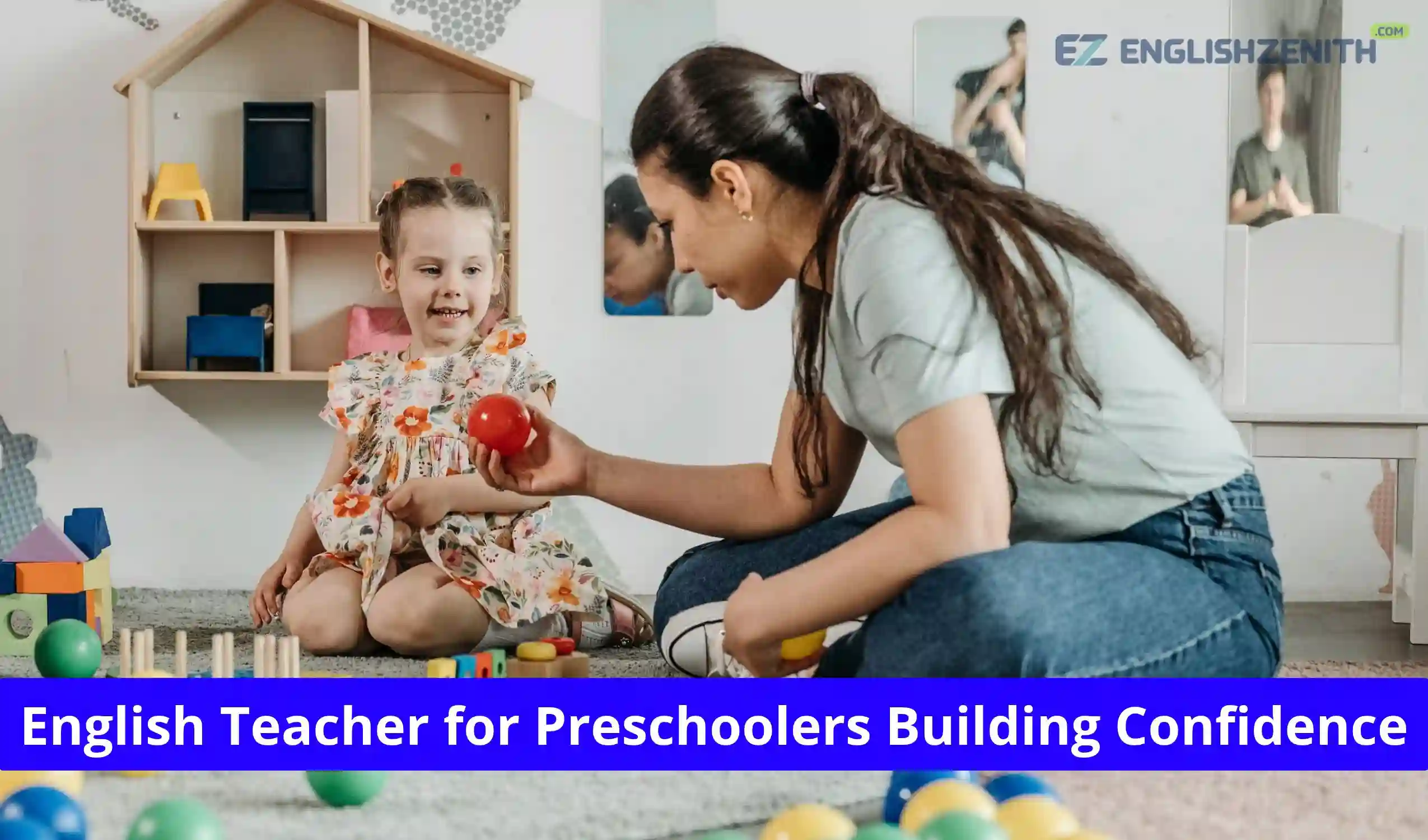
Preschool children benefit from language they can understand within a familiar context. A teacher might say, “Pick up the red ball,” while pointing towards the object, or use “Open the book” during a shared reading activity.
Through repeated exposure, children begin connecting spoken expressions with actions and objects. The teacher does not need to translate every sentence immediately because gestures, facial expressions, pictures, and demonstrations can support comprehension.
However, clarity matters more than speaking quickly or using complicated vocabulary. A skilled teacher chooses short expressions, repeats useful language naturally, and gradually introduces new words as the child becomes familiar with earlier material.
Patience Without Losing Learning Direction
Young learners sometimes hesitate, become distracted, or answer a question with a gesture rather than a word. Instead of treating these moments as failure, an effective teacher recognises them as opportunities to adjust the lesson.
For example, when a child cannot name an apple in English, the teacher might offer two picture choices or model the word slowly. This approach gives the child another way to participate while keeping the learning objective clear.
Nevertheless, patience does not mean allowing a lesson to become completely unstructured. Teachers still need to guide attention, maintain a comfortable rhythm, and return to the learning goal when children become distracted.
Encouragement That Builds Confidence
Positive feedback helps children understand which efforts matter. Instead of praising only correct answers, teachers can acknowledge careful listening, an attempt to repeat a phrase, or the courage to speak in front of another person.
Specific encouragement is particularly useful. A teacher might say, “You remembered the word blue,” or “You followed the instruction by yourself.” These comments connect praise with an observable action rather than giving children vague approval.
Over time, supportive feedback can help children approach unfamiliar language with greater confidence. The aim is not to make every answer perfect, but to help children feel comfortable participating and learning from mistakes.
How Preschool English Teachers Support Language Development
Children develop language through several connected abilities, including listening, understanding, speaking, and gradually recognising written words. A thoughtful teacher introduces these abilities in manageable steps while allowing them to reinforce one another.
Listening Comes Before Confident Speaking
Some preschoolers understand familiar English expressions before they can say them independently. A teacher can support this stage through simple instructions, picture matching, songs, and everyday classroom routines.
For example, children might respond to “Touch your nose” or “Show me the big circle.” These activities help teachers observe whether learners understand spoken language without requiring a complete verbal answer every time.
As comprehension grows, the teacher can invite children to repeat words, complete familiar phrases, or answer simple questions. This gradual progression respects individual readiness while creating regular opportunities to practise speaking.
Vocabulary Through Meaningful Context
Memorising isolated words does not always help children use language in everyday situations. An English teacher for preschoolers can introduce vocabulary through themes that children already recognise, such as family members, food, clothing, animals, and daily routines.
During a food activity, for instance, a teacher might introduce apple, banana, milk, and bread. The children can then practise expressions such as “I like apples” or “I want milk” when the situation makes those phrases meaningful.
The teacher can revisit the same vocabulary through picture cards, stories, pretend play, and simple conversations. This variety gives children repeated exposure without requiring every activity to look identical.
Early Grammar Through Useful Expressions
Preschoolers do not usually need lengthy grammar explanations. Instead, teachers can introduce useful sentence patterns through repetition and everyday interaction.
Expressions such as “This is my bag,” “I have a cat,” and “Where is the ball?” provide practical models that children can adapt. The teacher can demonstrate the pattern, invite participation, and gradually encourage children to create their own responses.
Although explicit grammar terminology may not suit every preschool lesson, accurate language modelling still matters. Teachers should use clear, natural English so children hear consistent examples as they develop their understanding.
Teaching Techniques That Make Classroom Learning Effective
A well planned preschool lesson balances clear learning goals with enough flexibility to respond to children’s attention and interests. The teacher selects activities for a reason, observes how children respond, and changes the approach when necessary.
Storytelling With Questions and Visual Support
Picture books offer opportunities to introduce vocabulary, demonstrate sentence patterns, and build listening comprehension. Teachers can point to illustrations, describe characters, and ask simple questions that invite children to notice details.
For example, a story about a dog can introduce words such as run, jump, big, and small. The teacher might ask, “Where is the dog?” before inviting the child to describe what the character does.
However, storytelling works best when the teacher allows children to participate rather than simply reading every page without interaction. A short pause, a repeated phrase, or a question about a familiar picture can turn listening into an active learning experience.
Songs and Movement With a Clear Purpose
Songs can help children hear rhythm, practise pronunciation, and remember recurring expressions. Movement adds a physical response that may help children connect language with meaning, especially when the teacher uses consistent actions.
For instance, a song about body parts can encourage children to identify their hands, feet, and head. Meanwhile, movement instructions such as “Stand up” and “Turn around” provide listening practice within a simple routine.
Teachers should still select songs carefully. Repeating music without a learning objective may entertain children, but connecting the song to a specific vocabulary set or instruction gives the activity greater educational value.
Guided Conversation and Pretend Play
Pretend play gives children a reason to use English for a practical purpose. A teacher might create a small shop where children practise naming food, asking for an item, or responding to “Here you are.”
The teacher can model each exchange before inviting children to try it independently. If a child struggles to respond, the teacher may offer a phrase to complete or demonstrate the answer with a toy.
This method creates opportunities for communication without demanding long speeches. It also helps teachers notice whether children can use familiar expressions beyond the original activity.
How an English Teacher for Preschoolers Measures Progress
Visible progress does not always mean that a child can recite a long list of vocabulary words. At preschool age, teachers should look for meaningful changes in comprehension, participation, recall, and the ability to use familiar language in different situations.
Observe Skills Rather Than Count Words Alone
A teacher can monitor whether a child follows a familiar instruction, recognises a word in a picture, responds to a simple question, or attempts a phrase without direct prompting. These observations offer a more complete picture than a vocabulary count alone.
For example, a child might recognise five animal names but still need support when the teacher asks, “Which animal can swim?” Another child might know fewer names but respond accurately to simple questions about familiar animals.
Neither observation should automatically determine a child’s overall ability. Instead, teachers can use such differences to identify the next appropriate learning goal and decide which concepts need more practice.
Use Small Learning Goals
Clear goals help teachers organise lessons and explain progress to parents. One goal might involve recognising familiar colours, while another could focus on following two related instructions or using a simple phrase to express a preference.
Teachers can revisit these goals over several lessons and note whether children respond with less assistance. They can also introduce new challenges when a learner demonstrates consistent understanding.
Importantly, progress may vary across skills. A child can understand many expressions while remaining reluctant to speak, so teachers should avoid assuming that every language ability develops at the same pace.
Communicate Observations to Parents
Parents benefit from specific updates rather than general statements that a child is doing well. A useful update might explain that the child now follows familiar classroom instructions independently but still needs encouragement to answer open questions.
This information helps parents understand what the teacher has observed and which skills the next lessons will reinforce. It also creates opportunities to share relevant details about the child’s interests, routines, or experiences with English outside class.
For a broader look at individual instruction, parents can explore private English tutoring in a one to one setting. Individual lessons can offer teachers more opportunities to observe a child’s responses and adapt activities to specific learning needs.
What Parents Should Look for During a Trial Lesson
A trial lesson can help parents understand how a teacher communicates with a preschooler. Rather than expecting the child to produce impressive results immediately, observe how the teacher introduces activities, responds to hesitation, and adjusts explanations.
Notice the Balance Between Guidance and Independence
A strong teacher gives children enough support to understand an activity without doing everything for them. For instance, the teacher might demonstrate how to match pictures before inviting the child to complete the next pair independently.
If a child makes a mistake, observe whether the teacher provides a useful hint, models the answer, or offers another opportunity to try. These responses can reveal more about teaching quality than a polished presentation alone.
Parents can also consider whether the child receives opportunities to make choices, ask questions, and respond in different ways. A lesson should provide structure while leaving room for age appropriate participation.
Check Whether Instructions Suit the Child’s Age
Long explanations can overwhelm young learners, particularly when they encounter unfamiliar vocabulary at the same time. Teachers should break tasks into manageable steps and check understanding before adding further instructions.
Visual support can help, but it should serve the learning objective rather than distract from it. Pictures, objects, and gestures work best when they clarify meaning and encourage children to engage with the language.
Parents should also notice whether the teacher adjusts the pace when attention begins to fade. Short changes in activity may help restore focus without abandoning the lesson’s main purpose.
Ask How the Teacher Plans Future Lessons
A thoughtful teacher should be able to explain what the child is learning, how the teacher observes progress, and how future lessons will build on previous experience. The explanation should be understandable and specific rather than relying on broad promises.
Parents may ask how the teacher supports a shy learner, introduces new vocabulary, or responds when a child finds an activity difficult. The answers can reveal whether the teacher follows a considered teaching approach.
For families considering online learning, online English lessons for preschoolers provide another topic to explore when comparing learning formats. The important question is whether the teacher can make the chosen format interactive, manageable, and appropriate for the individual child.
Choosing the Right Learning Format for Preschool English
The most suitable learning format depends on the child’s attention, learning preferences, family routine, and opportunities to interact with the teacher. Parents should consider these factors alongside teaching quality rather than assuming that one format works equally well for every preschooler.
Individual Lessons for Personalised Attention
One to one lessons can give a teacher more time to observe a child’s responses, repeat challenging material, and adjust the pace. This format may suit learners who need additional encouragement or benefit from activities tailored to their current abilities.
However, individual instruction still requires thoughtful planning. A teacher should vary activities, encourage interaction, and set realistic goals rather than relying on repetition alone.
Parents interested in this approach can review private English tutoring for preschoolers to understand how individual teaching may fit their child’s needs. The key consideration remains the quality of the learning experience rather than the format by itself.
Online Lessons That Encourage Participation
Online lessons can provide access to a teacher without requiring families to travel. When teachers use clear visuals, short activities, and frequent interaction, young learners can practise listening and speaking through a screen.
Nevertheless, online learning requires practical preparation. Parents may need to provide a quiet space, check the internet connection, and remain available when a child needs help navigating the lesson.
Teachers should also recognise the limitations of screen based interaction. They can vary the pace, invite physical responses, and use familiar objects to maintain engagement rather than expecting preschoolers to sit still throughout an extended explanation.
Families who want to understand this format further can read about an online English tutor for preschoolers. Comparing the teacher’s interaction style, lesson structure, and communication with parents can help families make a more informed decision.
Common Mistakes to Avoid When Teaching Preschool English
Even enthusiastic teachers can make lessons less effective when they focus too heavily on performance. Understanding common mistakes helps parents recognise an approach that supports gradual learning rather than creating unnecessary pressure.
Expecting Immediate Fluency
Preschool children need time to become familiar with a new language. A child may understand a phrase for several lessons before using it independently, so parents should avoid treating every quiet response as evidence of poor teaching.
Instead, look for gradual changes in comprehension, confidence, and participation. Teachers can create opportunities to speak while allowing children to respond through gestures, choices, or short expressions when appropriate.
Correcting Every Small Error
Frequent correction can interrupt communication and make some children reluctant to participate. Teachers should prioritise the language goal of an activity and respond in ways that keep the conversation moving.
If a child says, “He go home,” the teacher might naturally reply, “Yes, he goes home.” This gives the child an accurate model without turning every exchange into a grammar test.
Comparing Children With Their Peers
Children differ in their previous exposure to English, communication preferences, and readiness to speak. Comparing one learner with another can overlook these differences and create expectations that do not reflect individual progress.
Teachers should instead track each child’s development against appropriate learning goals. This approach helps parents understand what their child can do now and which skills deserve attention next.
Frequently Asked Questions About an English Teacher for Preschoolers
What does an English teacher for preschoolers do?
An English teacher for preschoolers helps young children develop early listening, vocabulary, speaking, and comprehension skills. The teacher uses age appropriate activities, clear language, repetition, stories, and guided interaction to make English understandable and useful.
What qualifications should a preschool English teacher have?
Parents can look for strong English proficiency, relevant teaching experience, and an understanding of early childhood development. Experience with young learners matters because teaching preschoolers requires different communication strategies from teaching teenagers or adults.
How can a teacher help a shy preschooler speak English?
A teacher can begin with listening activities, picture choices, gestures, and familiar phrases before inviting longer verbal responses. Encouragement, predictable routines, and manageable challenges can help a child participate without feeling pressured to speak before feeling ready.
How long should an English lesson last for preschoolers?
The appropriate lesson length depends on the child’s age, attention, activity, and individual needs. Teachers should monitor engagement and use varied activities rather than assuming that a longer lesson automatically produces better learning.
How can parents recognise progress in English?
Parents can look for changes such as following familiar instructions, recognising vocabulary, responding to simple questions, and attempting expressions during everyday activities. Progress may appear gradually, so consistent observations are more useful than judging a child’s ability from one lesson.
Are online English lessons suitable for preschool children?
Online lessons can suit preschoolers when teachers provide active interaction, clear visual support, manageable tasks, and regular opportunities to respond. Parents should also consider the child’s comfort with screens, access to a suitable learning space, and the level of adult support required.
Help Your Child Build a Strong Start With English
The right English teacher for preschoolers does more than introduce new words. A thoughtful teacher creates meaningful opportunities to listen, understand, communicate, and develop confidence while respecting the child’s individual pace.
For parents, the best starting point is to look beyond attractive lesson materials and focus on how the teacher guides learning. Clear explanations, purposeful activities, careful observation, and constructive communication can make the learning experience more valuable over time.
English Zenith offers an opportunity to explore English learning options that suit your family’s goals. Visit the English Zenith website to learn more and discuss an appropriate starting point for your child.